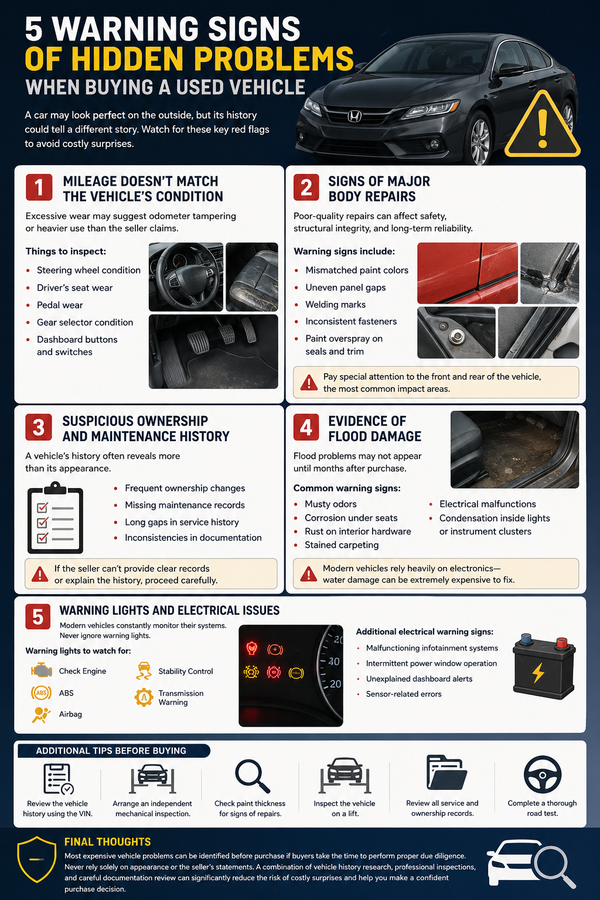
Why Some Accidents Never Appear on Carfax Reports — And What Smart Buyers Do Instead

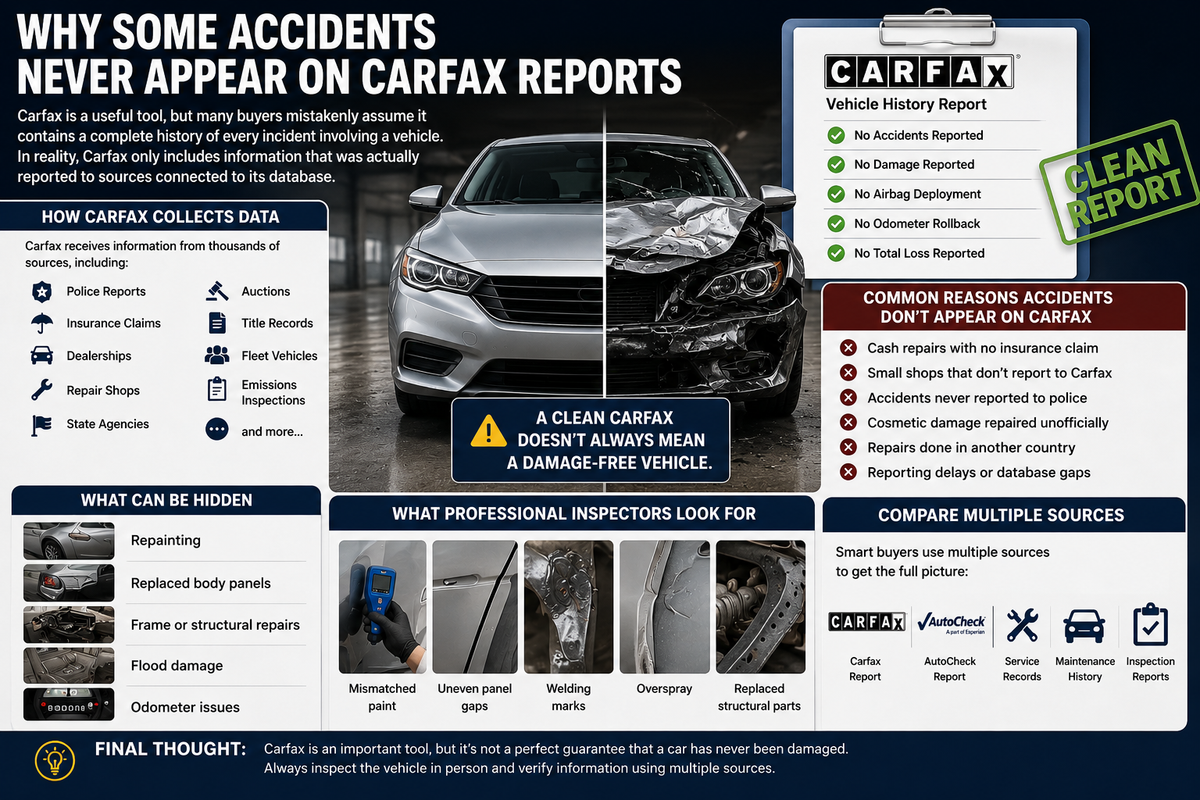
For millions of used car buyers, a clean Carfax report feels like a safety guarantee.
People often assume that if Carfax shows no accidents, the vehicle must have never been seriously damaged.
Unfortunately, the real used car market is far more complicated.
Carfax is one of the most valuable vehicle history databases available today, but it is not a complete record of everything that has ever happened to a car. It only contains information that was actually reported to systems connected to the Carfax network.
That distinction matters much more than many buyers realize.
A vehicle can have major repairs, repainting, flood exposure, structural work, or even previous auction damage while still showing a relatively clean history report.
This is one of the biggest misconceptions in the automotive market today.
How Carfax Actually Gets Information
Carfax does not physically inspect vehicles.
Instead, it collects data from thousands of external sources, including:
- insurance companies;
- police accident reports;
- state DMV agencies;
- dealership service centers;
- emissions inspections;
- salvage auctions;
- partner repair facilities;
- fleet companies;
- maintenance providers.
When an accident becomes part of one of these systems, there is a good chance the event may eventually appear on the report.
But if the damage never enters those systems, Carfax may never know it happened.
That is where many buyers get surprised.
Why Some Accidents Never Show Up
There are many situations where damage remains completely invisible to history databases.
Some are innocent.
Some are intentional.
And some exist simply because the automotive reporting ecosystem is fragmented.
Private Cash Repairs
This is probably the most common reason.
Imagine a driver backs into another vehicle or hits a barrier. Instead of filing an insurance claim, they simply pay a local body shop directly.
No police report.
No insurance involvement.
No official claim.
No digital reporting trail.
The repair gets completed quietly, and the vehicle history may remain completely clean.
For buyers later reviewing the Carfax report, the accident essentially never existed.
Small Independent Repair Shops
Not every repair facility reports information to Carfax.
Large dealerships and national chains are more likely to participate in data-sharing systems. Small local body shops often do not.
A vehicle could receive:
- bumper replacement;
- repainting;
- door replacement;
- suspension work;
- even structural repair
without the information ever reaching major databases.
The repair may be technically excellent — but invisible.
Cosmetic Damage Often Goes Unreported
Minor collisions are frequently repaired unofficially.
Owners may choose fast cosmetic repairs for:
- scratched bumpers;
- dented quarter panels;
- cracked headlights;
- parking lot damage;
- hail damage.
Because the repairs are relatively small, many owners never involve insurance.
The result is a vehicle that looks perfect during resale while carrying no digital repair history.
Flood Damage Is Sometimes Hidden
Flood-damaged vehicles are among the biggest concerns in the used car industry.
When insurance companies officially total flood vehicles, those records often appear in databases.
But not every flooded vehicle becomes an insurance total loss.
Some cars are cleaned, repaired, dried out, and resold privately before official branding occurs.
Others move across state lines or international borders.
Some eventually receive rebuilt titles.
Others simply disappear into the secondary market with limited reporting.
This is why flood exposure can remain difficult to identify through history reports alone.
Imported Vehicles Create Additional Gaps
International vehicle history reporting is inconsistent.
Cars imported from other countries may have incomplete accident documentation, especially if the original repair records never entered U.S.-connected systems.
Some imported vehicles arrive with:
- missing service history;
- incomplete ownership records;
- undocumented collision repairs;
- auction damage history unavailable domestically.
Buyers often assume a U.S. report reflects the car’s entire life history.
In reality, it may only reflect a portion of it.
Salvage Auctions and Rebuilt Vehicles
Salvage auctions are another important factor.
Many heavily damaged vehicles are repaired and later returned to the road.
Sometimes these repairs are disclosed properly.
Sometimes they are not.
Auction photographs may show:
- deployed airbags;
- crushed quarter panels;
- frame damage;
- severe front-end impact;
- water intrusion.
Months later, the same vehicle may appear on the market looking visually flawless.
Without auction research, many buyers would never realize the vehicle previously suffered major damage.
Why Timing Matters
Another issue buyers rarely consider is reporting delay.
Carfax data is not always instant.
Insurance claims, title updates, and repair documentation can take:
- days;
- weeks;
- sometimes months
before appearing in reports.
This means a recently repaired vehicle may temporarily appear cleaner than it actually is.
Some sellers exploit this timing gap intentionally.
What Experienced Buyers Always Check
Professional buyers rarely trust a single source.
Instead, they compare multiple layers of information.
This often includes:
- Carfax;
- AutoCheck;
- auction history;
- service records;
- dealership maintenance history;
- title records;
- independent inspections.
The goal is not just finding reported accidents.
The goal is identifying inconsistencies.
Physical Inspection Still Matters Most
Even the best database cannot replace a qualified inspection.
Experienced mechanics and body specialists often identify hidden repairs within minutes.
They look for warning signs such as:
- mismatched paint texture;
- overspray inside door jambs;
- uneven panel gaps;
- aftermarket welds;
- replaced bolts;
- missing factory stickers;
- corrosion in unusual locations;
- frame straightening marks;
- inconsistent underbody coatings.
Modern cosmetic repair quality can be extremely convincing.
A vehicle may look perfect in photographs while hiding extensive previous damage underneath.
The Psychological Trap of “Clean Carfax”
One of the biggest problems in the market is psychological.
Buyers see the phrase:
“Clean Carfax”
and immediately relax.
That emotional trust can cause people to skip inspections, ignore warning signs, or overpay for risky vehicles.
But a clean report does not necessarily mean:
- no accidents;
- no repainting;
- no flood exposure;
- no structural work;
- no prior auction damage.
It only means the database currently contains no major recorded incidents.
Those are very different things.
What Smart Buyers Do Instead
Experienced used car buyers treat Carfax as one tool — not the final answer.
They:
- verify the VIN across multiple sources;
- review maintenance consistency;
- inspect title history;
- research auction archives;
- compare mileage records;
- pay for professional inspections.
The smartest buyers understand that missing information can sometimes be more important than visible information.
Final Thoughts
Carfax remains one of the most valuable tools in the automotive industry.
It helps identify:
- ownership history;
- title branding;
- mileage anomalies;
- service records;
- many accident events.
But it is not magic.
No vehicle history platform can guarantee a car has never been damaged.
The used car market is filled with private repairs, undocumented collisions, delayed reporting, rebuilt vehicles, and hidden cosmetic work.
That is why smart buyers combine databases with real-world inspections and independent verification.
In automotive research, the safest assumption is simple:
A clean report should increase confidence — but never replace due diligence.